

Matrox ConvertIP: The Gold Standard for ST 2110 & IPMX
Convert SDI, HDMI, and HDBaseT to ST 2110 & IPMX networks with flawless image quality and near-zero latency using a fanless, standalone appliance.

SMPTE ST 2110
IPMX Ready
NMOS IS-04/05
High-Performance Bi-Directional Converters
Sub-Frame Latency Performance


Scalable 1G–25G Networks
Flexible Transport

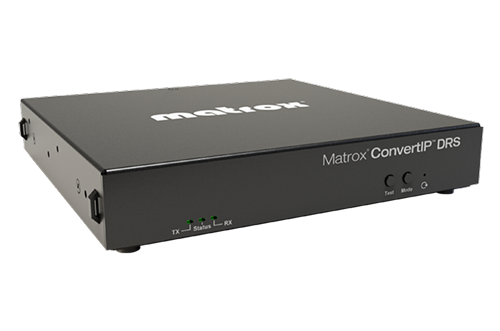
Dual-channel RJ45 SDI-to-IP converter
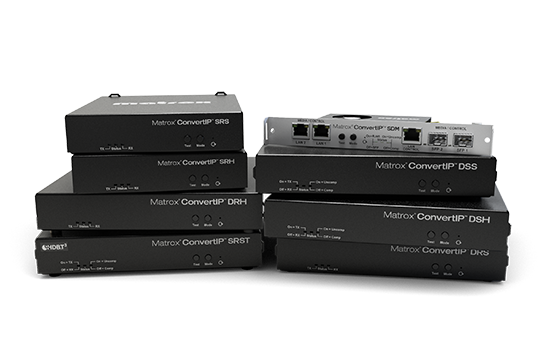
Matrox ConvertIP DRS is capable of receiving or transmitting ST 2110 or IPMX signals, and features 12G-SDI, genlock, and three RJ45 ports on a single device.
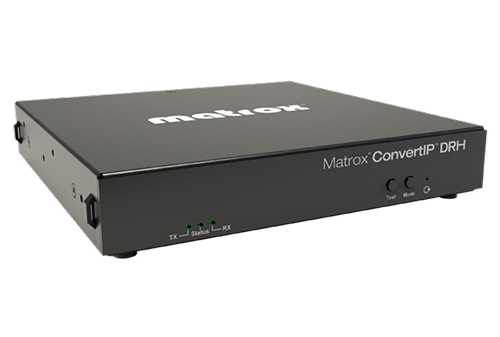
Dual-channel RJ45 HDMI-to-IP converter
Matrox ConvertIP DRH is capable of receiving or transmitting ST 2110 or IPMX signals, and features HDMI I/O and three RJ45 ports on a single device.
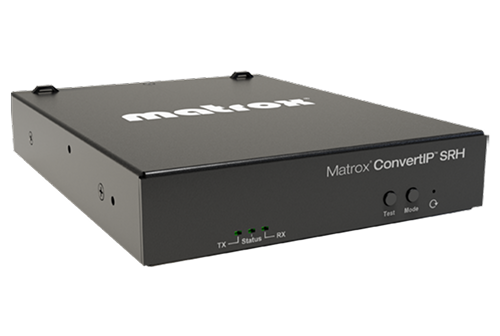
Single-channel RJ45 HDMI-to-IP converter
Matrox ConvertIP SRH is capable of receiving or transmitting ST 2110 or IPMX signals, and features one RJ45 port.
Single-channel SDI-IP transmitter/receiver
Matrox ConvertIP SRS is a compact, standalone ST 2110 and IPMX transmitter/receiver device. Delivering up to 4K60 image quality and featuring one RJ45 port, ConvertIP SRS is designed for both 1G and 2.5G AV workflows and is optimal for an ultra-low latency experience.
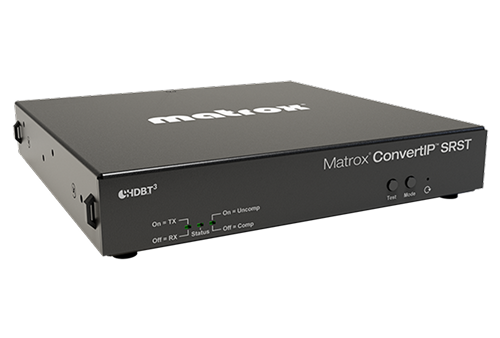
Single-channel RJ45/SFP HDBaseT™-to-IP converter
Matrox ConvertIP SRST is capable of receiving or transmitting HDBaseT™ signals, and features both RJ45 and SFP28 ports on a single device.
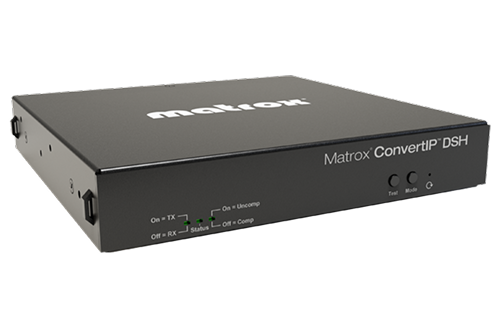
Dual-channel SFP HDMI-to-IP converter
Matrox ConvertIP DSH is capable of receiving or transmitting ST 2110 or IPMX signals, and features HDMI I/O, one RJ45, and two SFP28 ports on a single device.
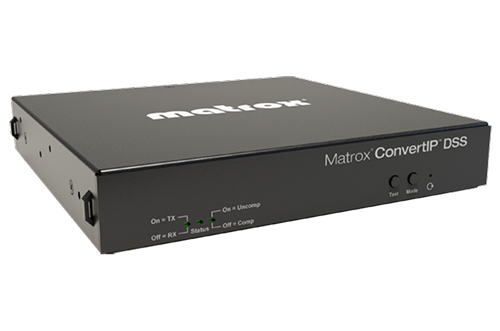
Dual-channel SFP SDI-to-IP converter
Matrox ConvertIP DSS is capable of receiving or transmitting ST 2110 or IPMX signals, and features 12G-SDI, genlock, one RJ45, and three SFP28 ports on a single device.
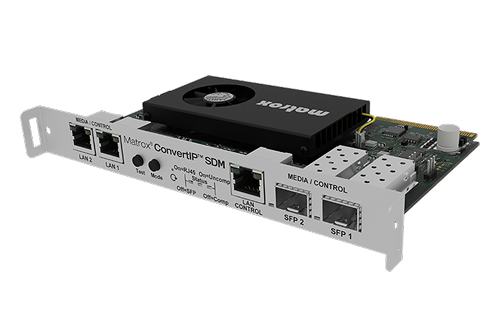
SMPTE 2110 and IPMX SDI receiver
Matrox ConvertIP SDM is an Intel® smart display module that supports ST 2110 and IPMX inputs. Designed for compressed or uncompressed workflows up to 25G and zero latency applications.

Frequently Asked Questions
Q: How do I convert SDI to ST 2110 without a total network overhaul?
ConvertIP acts as a universal gateway that adapts to your existing setup. You can transmit high-quality compressed JPEG XS signals over your current network with sub-frame latency. As your requirements grow, ConvertIP allows you to seamlessly scale toward uncompressed 25GbE workflows by adding a dedicated network at your own pace. Each ConvertIP device can also be configured as either a transmitter or receiver, so you only buy what your workflow needs.
Q: Is this truly "Plug-and-Play" with my existing broadcast controller?
Yes. ConvertIP integrates natively via NMOS IS-04 and IS-05. Devices are automatically discovered and registered by your network controller the moment they are connected, providing the familiar experience of traditional SDI routing in an IP environment. ConvertIP Manager software also lets you manage multi-unit installations, routing, and firmware updates from a single interface.
Q: We already have HDMI and HDBaseT sources. Does ConvertIP work beyond SDI?
Yes. The ConvertIP series includes dedicated models for HDMI and HDBaseT sources alongside SDI, so you can bring all your signal types onto a single ST 2110 or IPMX network without separate gateway hardware for each format.
Q: How can I integrate ConvertIP Series devices into my control system or application?
The ConvertIP Series is designed for easy integration into control and automation systems. It offers comprehensive APIs and SDKs for full device control, configuration, and monitoring. Pre-built Crestron and Q-SYS modules are also available, enabling fast and straightforward integration into these platforms as well as custom applications.
Q: In what types of deployments does the ConvertIP Series provide the most value?
The ConvertIP Series is particularly well suited for environments where SMPTE ST 2110 workflows are used in a live production studio, and there is a need to distribute that content beyond the studio. It enables seamless conversion and transport of 2110 streams into IPMX for wider distribution, making it ideal for extending high-quality media across campuses, corporate environments, or large facilities. This allows organizations to maintain broadcast-grade production while efficiently delivering content to a broader audience over standard IP networks.
Q: Is ConvertIP available in TAA-compliant configurations?
Yes. TAA-compliant SKUs are available for organisations with government or regulated procurement requirements. Contact a Matrox expert to confirm which models qualify for your deployment.
What Our Trusted Clients Have to Say
"The Matrox ConvertIP Series will serve as a practical foundation for how we want to build and manage our ST 2110 environments going forward, enabling incremental deployment, operational continuity and long-term scalability."

“The venue’s technical team highlighted that the devices added "significant flexibility" for placing media servers and that Matrox's support was instrumental in the firmware and switch compatibility phase.”

“By using ConvertIP, they could use the same hardware for both tasks. The project demonstrated ConvertIP’s "interoperability and future-proof design," allowing the client to switch between compressed and uncompressed modes based on the network and use case.”

See ConvertIP in Action: Live Booth Demo
ConvertIP ST 2110 and IPMX for Live Event Production
Ready to Test ConvertIP?

- Matrox Video
- Global Headquarters
- 1055 St. Regis Blvd.
- Dorval, Quebec
- Canada H9P 2T4
- 1-800-361-4903


Matrox Video is a global leader in video technology. Featuring a complete portfolio of best-in-class hardware, software, APIs, and SDKs, Matrox Video enables OEMs, system integrators, value-added channel partners, and end users to push the boundaries of video innovation. Serving the AV/IT, broadcast, and emerging markets for over 50 years, Matrox Video is synonymous with quality, performance, interoperability, and support. Matrox Video’s legal entity is Matrox Graphics Inc., part of the Matrox Group.